Airport security is often the stage where a family has to manage several small tasks at exactly the same moment: coats, bags, liquids, children and perhaps a stroller that needs to be folded. Understanding the process makes a significant difference. Hamburg Airport provides a specific lane arrangement for families, and the rules for baby food also include useful exceptions that parents should know before reaching the checkpoint.
Families with young children use the family lane
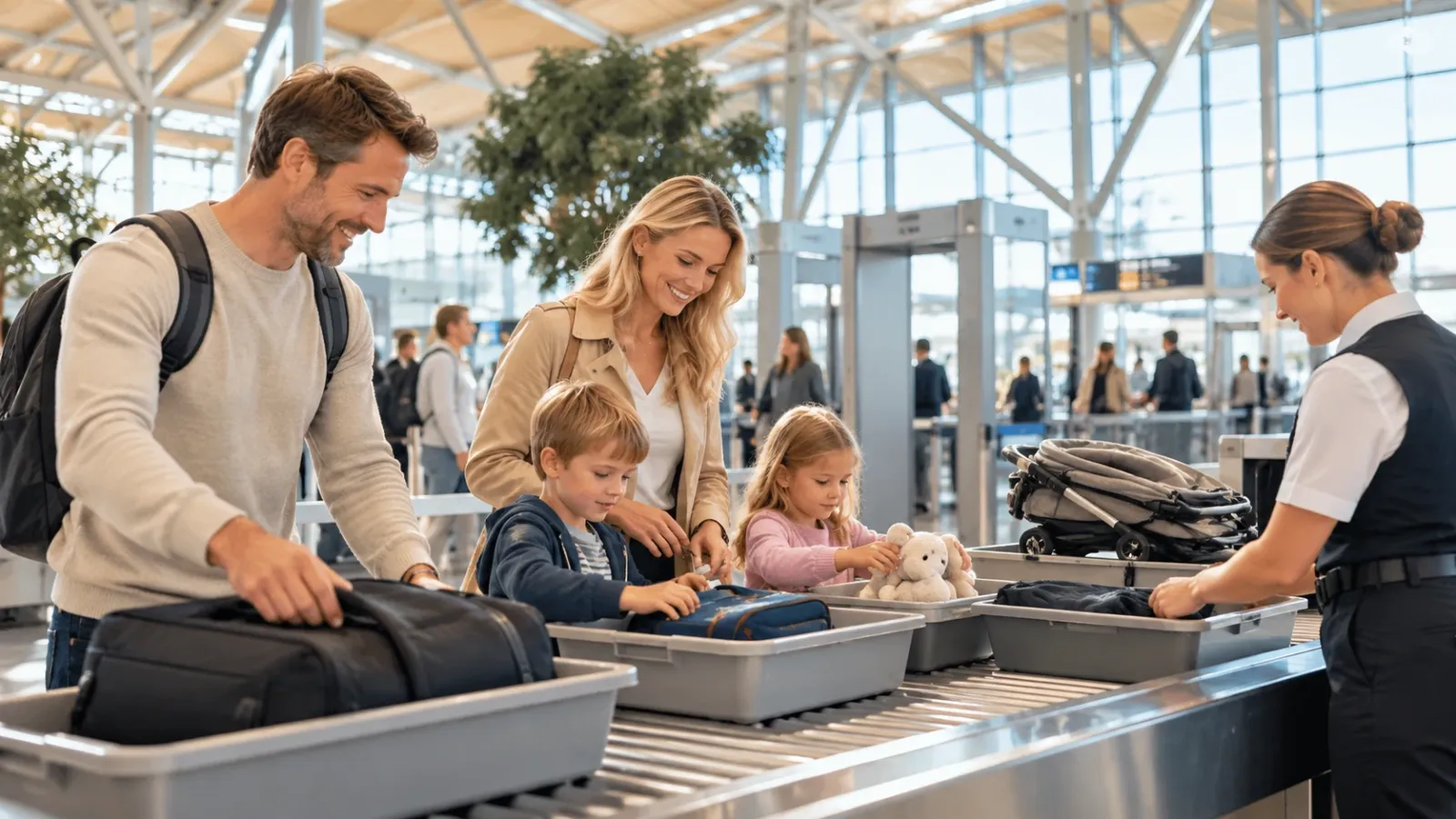
Hamburg Airport states that families with children aged zero to six may use the PRM/family lane in the Airport Plaza. The airport also notes that Slot&Fly and the Fastlane are not available to these passenger groups for technical reasons. That is an important planning detail because parents should not build their schedule around a security service that is not intended for them.
Follow the airport signs and staff instructions on the day. If you have several cabin bags, a stroller and young children, organise yourselves before reaching the front of the queue. One adult can prepare travel documents and bags while the other focuses on the children, rather than both trying to do everything at once.
Baby food can exceed the normal 100 ml limit
The general liquids rule causes many questions for parents, but baby food has a specific exception. Hamburg Airport explains that milk, porridge and jars needed for the journey may be carried in cabin baggage and may exceed the usual 100 ml container limit. The quantity should be reasonable for the planned travel period. Necessary liquid medication may also be carried.
Keep these items accessible. It is far easier to present a bottle or jar from a dedicated pocket than to unpack a completely full changing bag at the checkpoint. A small, clearly organised pouch for food and medication can save time. Follow the security staff's instructions for formula, feeding equipment and any additional screening that may be required.
Prepare the stroller before the checkpoint
Whether a stroller can stay with you until the gate depends on the airline. If the buggy is going through security, it also needs to be screened. Remove bags, drinks, toys and other loose objects before reaching the conveyor. A stroller that can be folded quickly and is not covered in accessories is much easier to manage.
If the stroller was already handed over as bulky baggage after check-in, this step disappears. In that case, however, think about how you will move the child through the terminal. A baby carrier or, where the airline permits it, a very compact cabin buggy can be useful depending on the child's age and the length of the walk.
Pack cabin baggage for the checkpoint, not just the flight
Family hand luggage works best when frequently inspected items are easy to reach. Travel documents, medication, baby food and electronics should be near the top or in dedicated compartments. Items only needed once you are seated on the aircraft can be packed deeper. Many loose objects spread across several bags make the checkpoint unnecessarily difficult.
Also prepare for the possibility that checked baggage does not arrive immediately at the destination. Nappies, spare clothing, essential medication and a small basic supply for the child should remain in cabin baggage. This is not strictly a security rule, but it is one of the most useful ways to make family travel more resilient.
Explain the process to children
Young children often cope better when they know what is about to happen. Explain simply that the bags will travel through a machine for a moment and that everyone gets their things back afterwards. If a favourite toy must go into a tray, telling the child before the last second can prevent an avoidable upset.
Older children can have a small job: carry their own backpack, hold their jacket or help check after security that the family's items are complete. Giving them a role can make the process feel less chaotic and leaves parents with fewer simultaneous tasks.
Time is more valuable than a shortcut
Hamburg Airport generally recommends being at the airport around two hours before departure. With children, that guidance is especially useful. The purpose is not to spend as long as possible at the gate; it is to absorb normal unpredictability. A crowded check-in area, a toilet stop or handing over a stroller at bulky baggage can all add time.
If you are arriving by pre-booked car, do not schedule the pickup around an unrealistically tight airport arrival. Work backwards so that the airport's recommended arrival time can still be met when road conditions are a little slower than expected. At the start of school holidays or during major events, additional margin may be sensible.
A direct journey can preserve energy for the airport itself
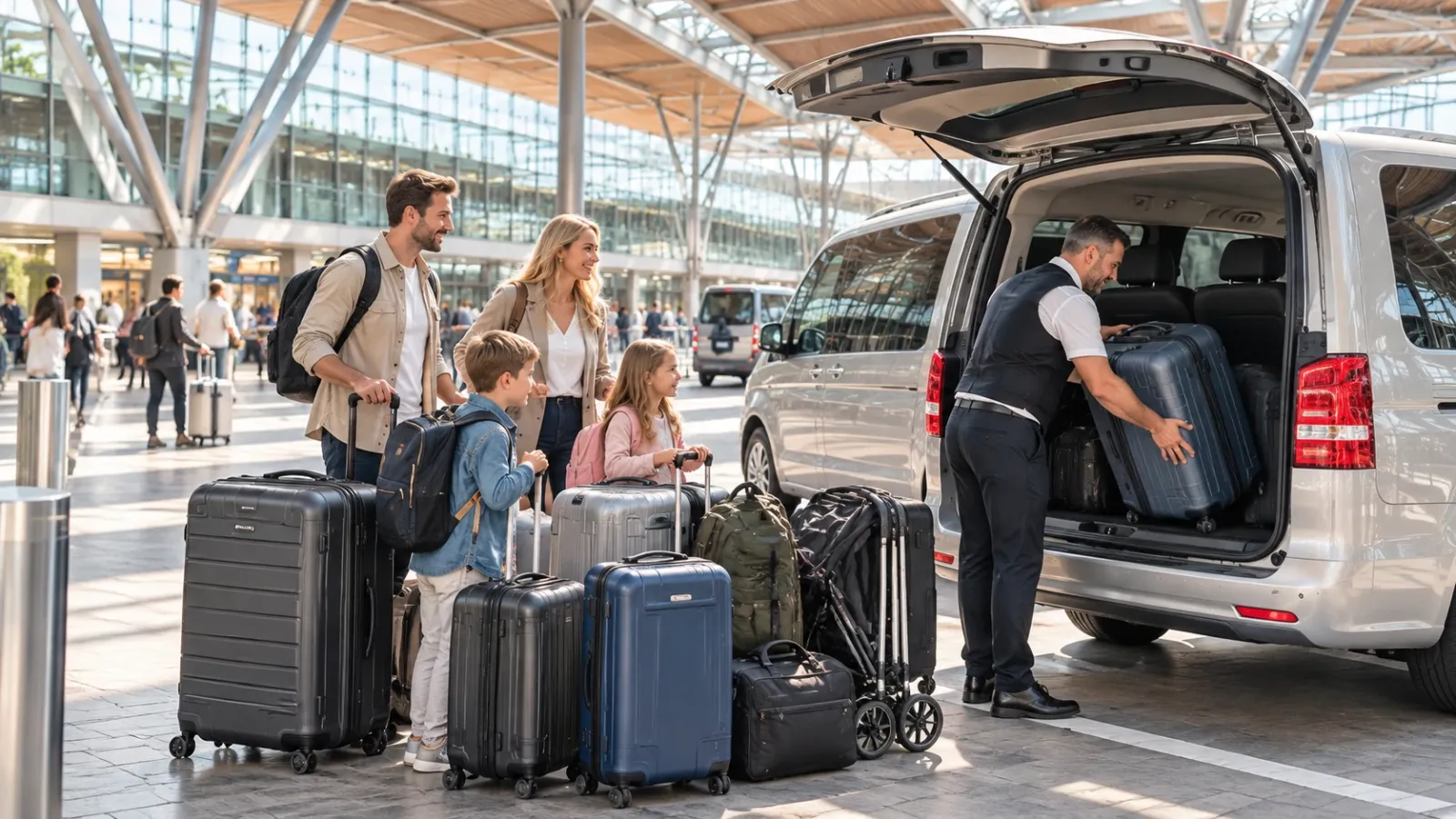
Security cannot be skipped, but families can arrive there with more energy. Parents who have already carried several suitcases and a stroller through changes on public transport face the checkpoint differently from a family dropped directly at the terminal.
A pre-booked Hamburg Airport transfer can simplify that first part of the day because child-seat needs, passenger count and luggage are stated before pickup. Once at HAM, the family's attention can stay on check-in, the family lane and the practical steps that matter most: keep things organised, allow time and move through the journey one stage at a time.