A stroller is both useful equipment and a piece of baggage on a flight. During an ordinary day it carries the child, bags and often half the family's belongings. At the airport, however, it may be treated as bulky baggage and need to be handed over at a particular stage of the journey. If you are flying from Hamburg Airport, the best preparation is to understand your airline's procedure before you travel. That prevents the awkward moment when you discover at check-in that the buggy must be taken elsewhere or cannot remain with you as long as expected.
Hamburg Airport treats strollers as bulky baggage
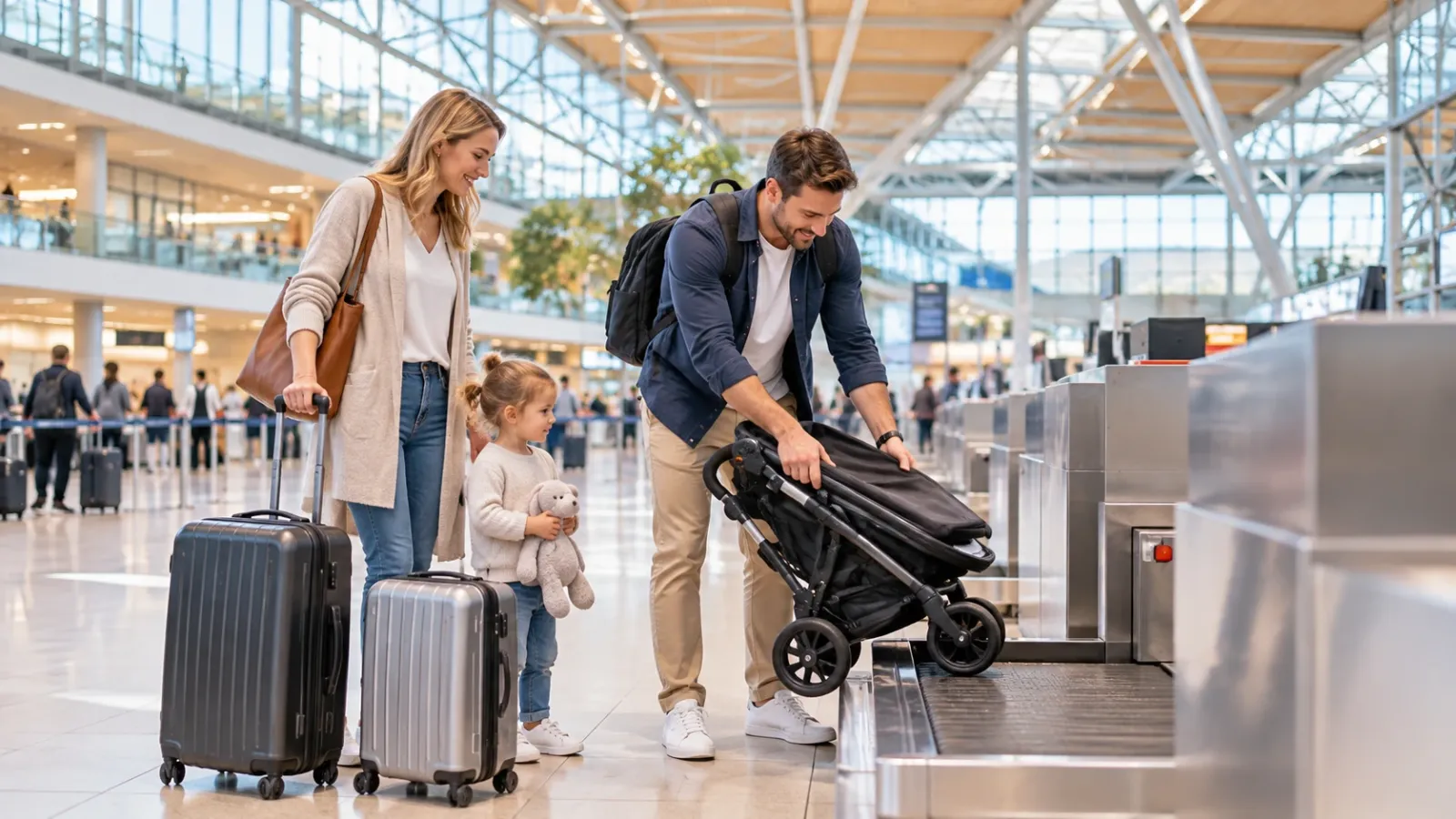
Hamburg Airport explicitly lists strollers and buggies among special or bulky baggage items. These items are not always accepted on the normal baggage belt. The airport provides bulky-baggage counters in Terminal 1 and Terminal 2. The important detail is that the exact handover procedure is set by the airline, so parents should check the carrier's rules before travelling.
In many cases, a stroller can be used after check-in until the gate or even until the aircraft. Ground staff then take it and load it into the hold. After landing, the stroller may be returned near the aircraft or delivered to a bulky-baggage area, depending on the airport and airline. On other flights, passengers may be instructed to hand it over at the bulky-baggage counter immediately after check-in.
Can a compact buggy travel in the cabin?
Some airlines accept particularly small, fully foldable buggies as cabin baggage, provided they meet the carrier's size and weight limits. This is not a universal Hamburg Airport rule. A product marketed as a “cabin buggy” is therefore not automatically permitted on every flight.
Check your airline's current hand-luggage dimensions against the actual folded measurements of the stroller. If the buggy is accepted in the cabin, that can make the terminal journey much easier. If it must travel in the hold, prepare it properly: remove cup holders, toys, detachable bags and other loose accessories. A protective cover can also make handling easier.
Gate check or bulky-baggage desk?
If your airline permits both options, the best choice depends on your child and travel routine. Keeping a stroller to the gate is valuable with toddlers who cannot comfortably walk long terminal distances. It can also carry a changing bag for much of the journey. If you use a baby carrier and have a large travel system, handing the stroller over earlier may be more convenient because you move through security with less bulky equipment.
Think about the arrival airport as well. Even when you hand the stroller over at the aircraft door, it may not be returned there. If it is delivered only with special baggage, you will still need to carry or walk with the child from the aircraft to baggage reclaim. A lightweight baby carrier in cabin baggage can be a useful backup.
Preparing the stroller for security screening
The stroller itself normally has to be screened. The exact process depends on its size and design, but you can make it faster by removing bags, blankets, bottles and toys before reaching the checkpoint. Keep travel documents, medicines, baby food and valuables in a separate bag that is easy to open.
Families with children aged zero to six can use the PRM/family lane in Hamburg Airport's Airport Plaza. The airport notes that Slot&Fly and the Fastlane are not available to these passenger groups for technical reasons. Knowing this in advance helps you plan realistically instead of relying on a security option that is not intended for your family.
Declare the stroller when booking an airport transfer
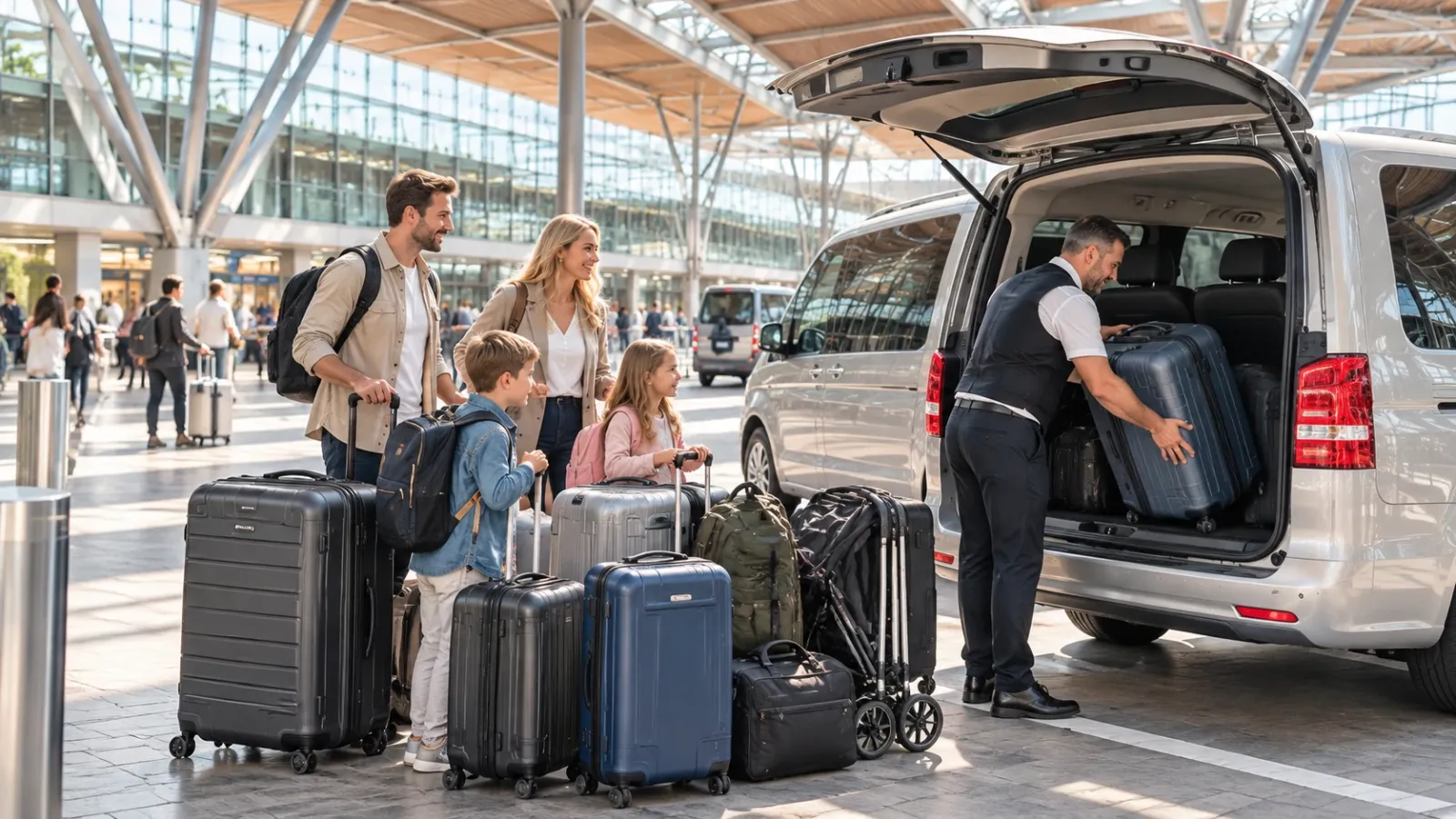
The stroller also needs space before you reach the airport. A small travel buggy may fit easily into the boot of a normal car. A large pushchair with frame, carrycot and detachable wheels can occupy a substantial amount of luggage space. Add full-size suitcases, cabin bags and perhaps a child seat, and the vehicle can fill much faster than the passenger count suggests.
When pre-booking a transfer, list the stroller as a bulky item. Flughafentransfer.Hamburg advises passengers to state all checked and hand luggage and to identify strollers or other oversized items separately. That information helps the booking partner assign a vehicle with enough safe capacity. A family of four with a large stroller may be more comfortable in a minivan even though four seats would technically fit in a smaller car.
Keep essentials out of the stroller basket
Before the travel day, decide what lives in the stroller and what belongs in hand luggage. Travel documents, keys, medication, baby food, spare clothes and electronics should be in a clearly defined bag that remains with you. Anything left in a stroller pocket can become a problem when staff ask you to fold and hand over the buggy quickly.
A simple routine works well: remove accessories before check-in, empty the basket before security and check the stroller one final time before gate handover. If you use a protective bag, label it clearly. For an expensive stroller, photograph its condition before checking it if you want a record in case you later need to follow the airline's baggage-damage process.
Make room for the buggy before the vehicle arrives
For families, the stroller is often the item that turns an ordinary airport ride into a luggage-planning exercise. A direct vehicle can simplify the first stage of the trip if the booking reflects the real amount of equipment. Include the stroller, suitcases, cabin bags and any requested child seat from the start.
With a pre-booked Hamburg Airport transfer, you can enter the family and luggage requirements before travel instead of trying to solve them at the curb. The goal is simple: the buggy should make the airport easier, not become the item that unexpectedly does not fit in the vehicle.