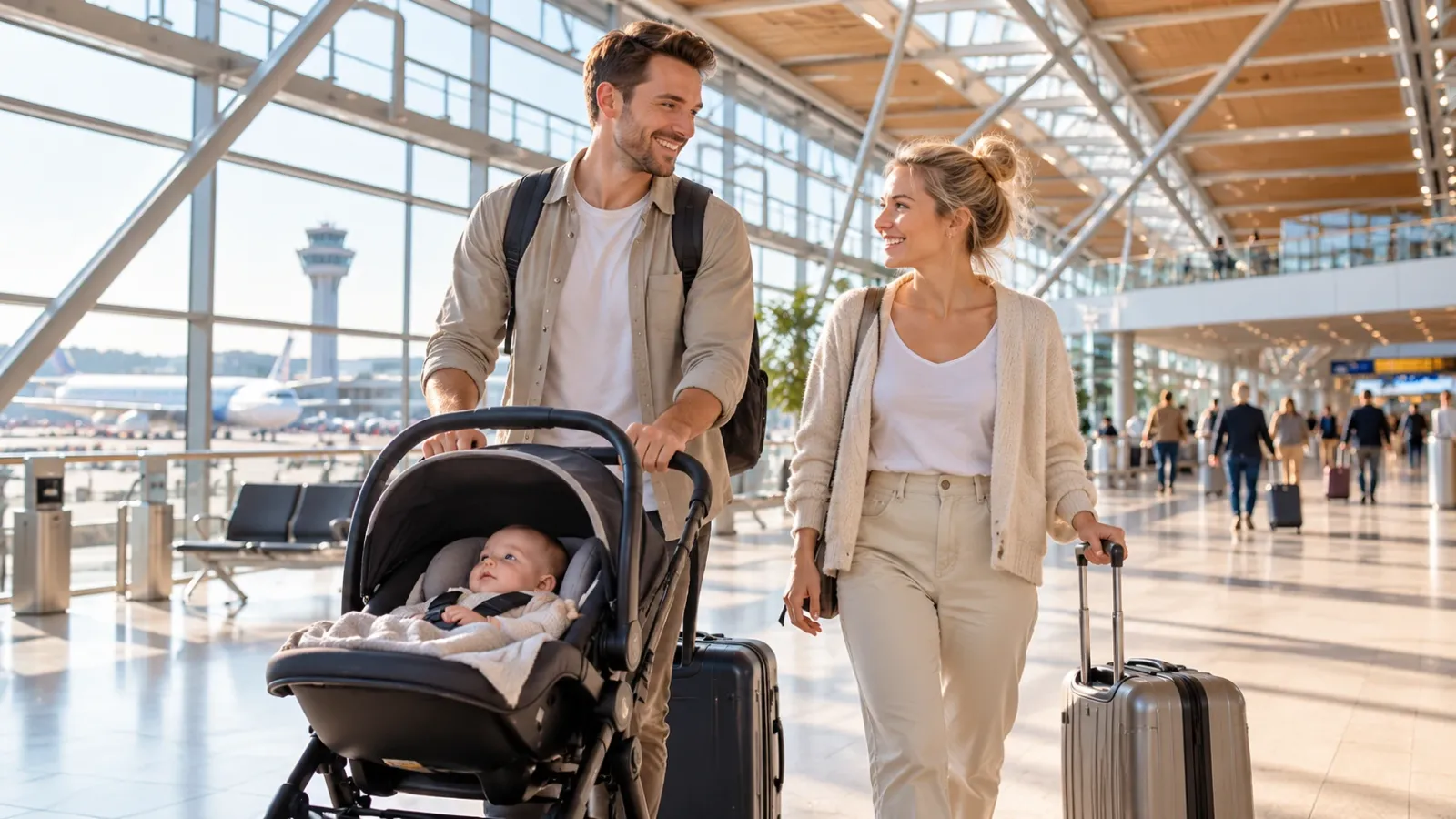
Flying with a baby is entirely manageable, but the journey starts well before boarding. The trip to Hamburg Airport can determine whether the day begins calmly or with two adults trying to manage suitcases, a stroller, a changing bag and a tired child at the same time. The main difference compared with travelling without children is not the distance to the airport; it is the number of small tasks that require extra time. Planning the infant seat, stroller, baby food and luggage before leaving home removes many of the common pressure points.
Start with realistic timing
Hamburg Airport generally recommends arriving around two hours before departure. With a baby, it is wise not to build your schedule around the last possible minute. A final nappy change, unexpected traffic, a busy security area or a stroller that must be checked at the bulky-baggage counter can easily add time. Work backwards from the moment you want to be inside the terminal: allow for the drive, getting everyone out of the house, loading the vehicle and a sensible margin for delays.
For very early flights, check when your airline opens check-in and baggage drop. Some airlines at Hamburg offer an evening-before check-in for eligible morning departures. If your airline and flight qualify, this can be particularly useful for a family because the large suitcase may already be gone when you leave home the next morning.
Arrange the infant seat before pickup
If you are travelling to the airport by car or pre-booked vehicle, the baby's restraint should be settled before the journey begins. A suitable infant carrier should not be something you hope to find at pickup. With a private transfer, choose the required seat during the booking process and check that the request appears in the confirmation. Flughafentransfer.Hamburg currently allows customers to select an infant carrier as part of the booking; children also count towards the passenger total.
If you are taking your own infant carrier, check the airline's rules for transporting it. Depending on the airline, seat model and aircraft, it may need to be checked or may be accepted in the cabin under specific conditions. Confirming this in advance is much easier than trying to solve the question at the check-in desk.
Strollers and buggies at Hamburg Airport
Hamburg Airport treats strollers and buggies as special or bulky baggage, but the exact procedure depends on the airline. The airport notes that in many cases families may keep a stroller until the gate or even until the aircraft, where ground staff take it for loading. Larger models may need to be handed over at the bulky-baggage desk after check-in. Some airlines permit very compact foldable buggies in the cabin if they meet the carrier's hand-luggage dimensions.
The practical lesson is simple: check the airline policy before travel. If the stroller can go to the gate, it is useful during the walk through the terminal. If it must be checked early, a baby carrier can make the journey through security and to the gate much easier.
Baby food, milk and medication at security
Baby food is an important exception to the usual liquids rules. Hamburg Airport states that jars, milk and porridge needed for the journey may be carried in hand luggage and can exceed the usual 100 ml limit. The amount should be reasonable for the planned travel period. Necessary medication can also be carried in hand luggage.
Keep these items accessible instead of burying them at the bottom of the changing bag. Bottles, jars, formula and medication may need to be shown during screening. Easy access saves time and prevents the entire bag from being unpacked. A change of clothes for the baby—and ideally a spare top for a parent—also belongs in hand luggage rather than the checked suitcase.
Family security lane and changing facilities
Families with young children aged zero to six can use the PRM/family lane in the Airport Plaza at Hamburg Airport. The airport states that Slot&Fly and the Fastlane are not available to these passenger groups for technical reasons. That makes it important to follow the family-lane instructions rather than assuming that a separately reserved security slot will be the fastest route.
Changing rooms are available in public and secure areas, and the airport also provides children's play areas. Arriving with enough time means these facilities can actually be useful rather than rushing straight from check-in to the gate. Before a longer flight, a quiet nappy change and a few minutes to reorganise the bags can make the next stage considerably easier.
Think about luggage volume, not only passenger numbers
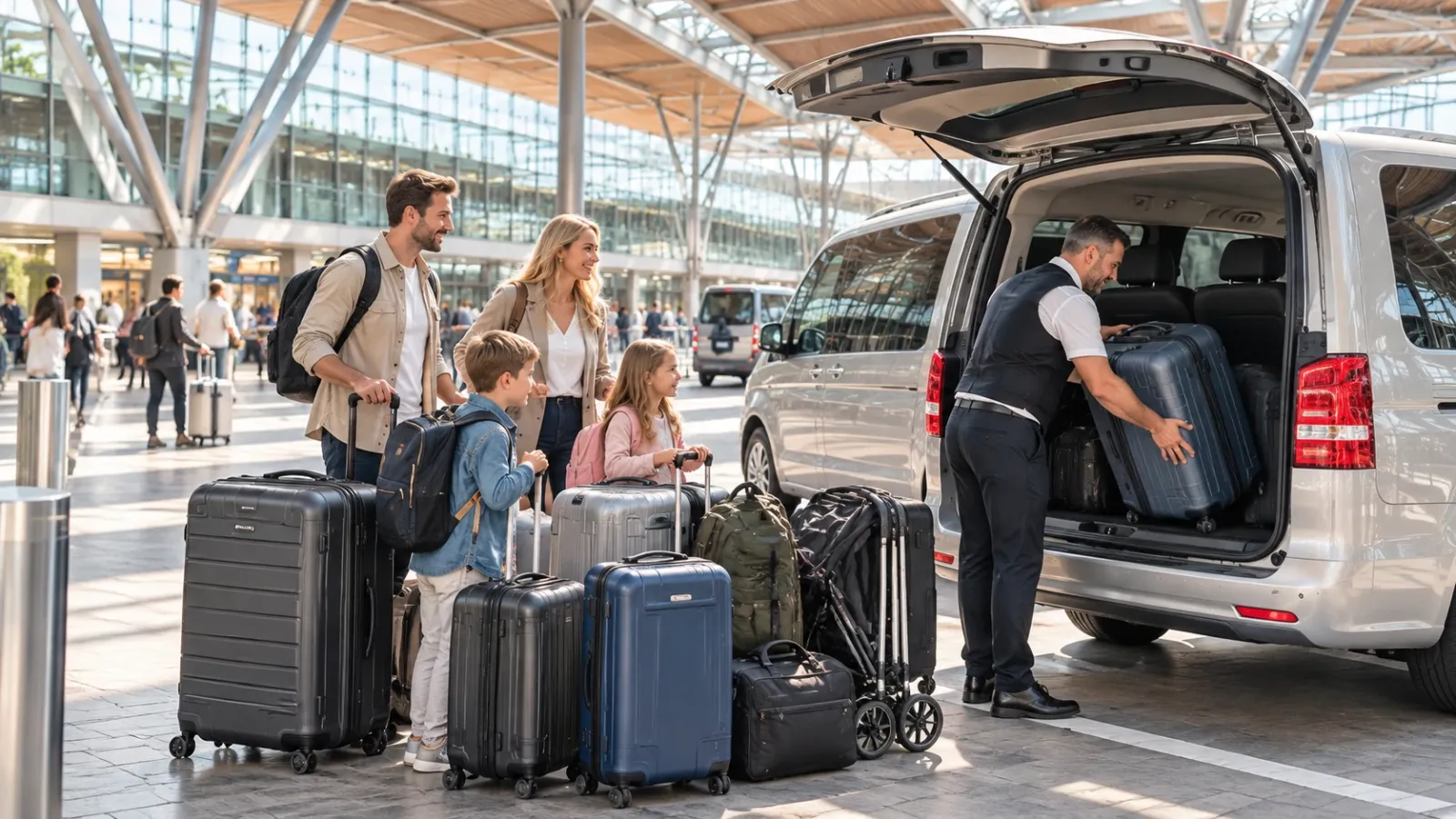
A baby creates a surprising amount of travel equipment: checked suitcase, cabin bag, changing bag, stroller, possibly a travel cot and perhaps an infant carrier. When booking a transfer, therefore, do not provide only the number of passengers. The quantity and type of luggage matter just as much. A car may have enough seat belts for the family but still lack the boot space for a large stroller and several full-size cases.
Declare bulky items clearly. For a small family, a minivan can sometimes be more comfortable than a standard saloon even when the seat count would technically fit. The aim is not to choose the largest possible vehicle, but one that safely accommodates people, child seat and baggage without last-minute rearranging.
Door to door can simplify the hardest part of the journey
Hamburg's public transport offers a good airport connection, but with a baby a direct journey can remove much of the physical organisation. There is no need to change trains, carry a stroller through stations or search for a suitable vehicle on departure morning. The key is accurate booking information: passenger count, infant seat and every significant piece of luggage.
If you want to plan the journey in advance, check a Hamburg Airport transfer and include the infant carrier, stroller and baggage during booking. That way the trip can begin with a straightforward pickup from your address rather than a transport problem before you have even reached the terminal.